What is Limo Dispatch Software
If you've been Googling around trying to figure out what "limo dispatch software" actually is, the marketing pages on every vendor site aren't going to help you.
They're all written in feature soup. "Comprehensive solutions." "Seamlessly integrated." "Industry-leading platform." Nobody tells you what the thing actually does in plain language.
So here. Let me try.
The job dispatch software is doing
A limo or taxi business has, essentially, three problems to solve every day.
How do bookings come in?
How do you assign the right car to the right job?
How do you get paid?
Everything else is detail.
Before dispatch software existed, all three of these were done with phones, paper, and shouting. Phones rang. Someone wrote down where to go. A guy with a radio yelled at drivers. Drivers came back at the end of the shift and turned in money or signed forms. It worked. It still works for some old-school operations. But it has problems. Things get forgotten. Bookings get double-assigned to two drivers. Customers call asking where their car is and nobody knows. The bookkeeper spends three days a month reconciling who got paid for what.
Dispatch software solves these problems by putting all three pieces — the bookings, the assignment, and the payment — into one system that everyone in the operation can see.
That's it. That's the core idea.
The four things every dispatch system has
Strip away the marketing, and every legitimate dispatch system has these four pieces:
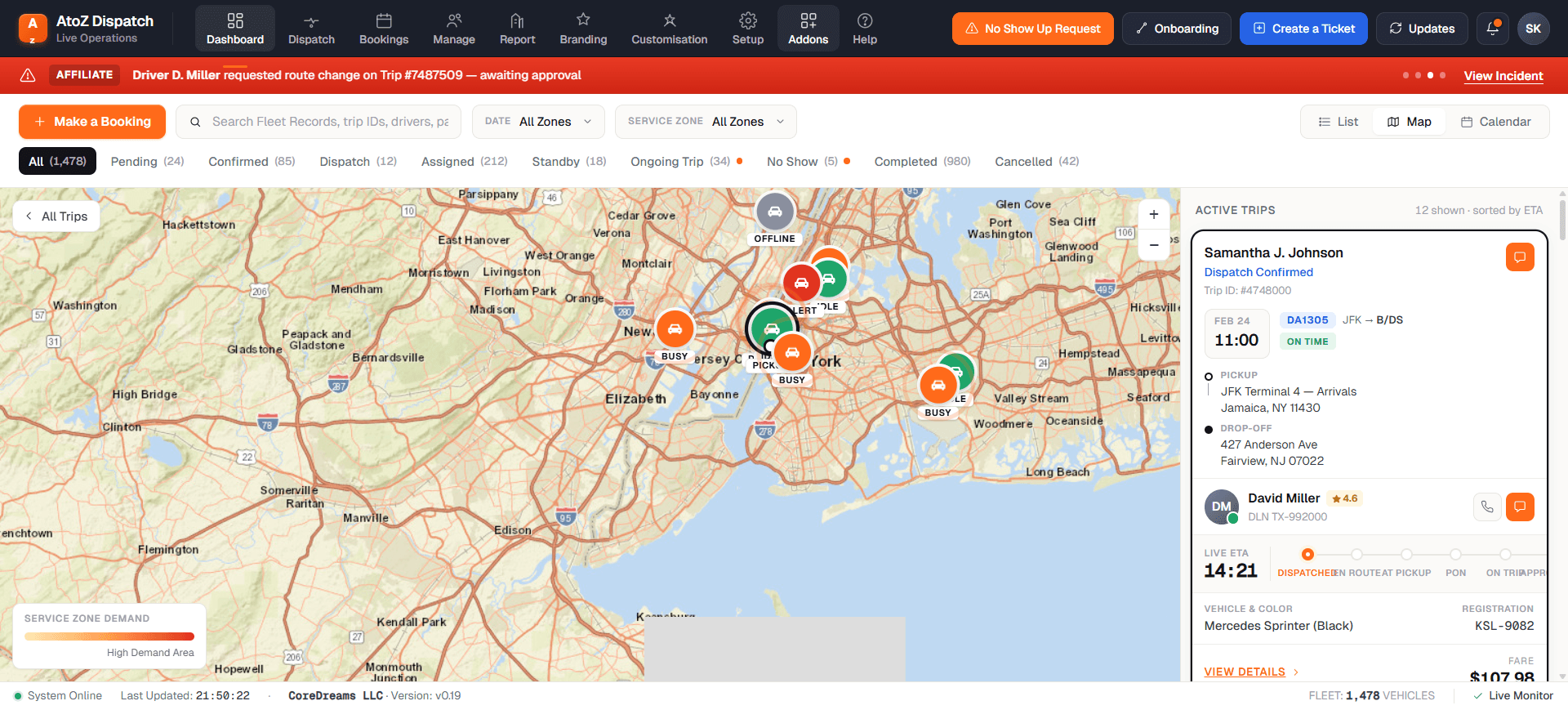
A dispatcher console. This is what the person at the office stares at. Map of all your cars. List of upcoming bookings. Buttons to assign drivers. Tracking of current trips.
A driver app. The thing on each driver's phone. Tells them where to go, when to be there, what the fare is. Lets them mark when they arrived, when they started, when they finished.
A way for customers to book. Phone bookings (where your office takes the call). Website bookings (through a widget on your site). App bookings (where your customers download an app). Some businesses use one of these. Some use all three.
A way to handle the money. Either through the dispatch system directly (it processes the cards) or through a connected payment processor like Stripe.Everything beyond these four pieces is bonus features.
Once you have the four basics, vendors try to sell you on features that may or may not matter for your business. Here's my honest take on which ones do.
Flight tracking. Matters a lot if you do airport runs. Worthless if you don't. We include it because most of our customers run JFK, LGA, LAX, ORD work and they need it.
Corporate account billing. Matters a lot if you have any business clients with Net 30 terms. Worthless if you're mostly cash and credit card retail. Most small operators end up needing this within their first 18 months as they grow.
White-label passenger app. This means the app customers download is branded as your business, not as the software company. Matters a lot if you're building a brand. Matters less if you're mostly doing one-off airport runs.
Reports and analytics. Sounds important. Mostly isn't. Almost everyone exports their data to a spreadsheet and does their own math in Excel anyway. Don't pay extra for fancy reports.
Driver performance scoring. Software companies love this feature. Operators don't use it. You know who your good drivers are. You don't need a number.
Multi-zone pricing. Matters in cities with toll zones, congestion zones, or airport surcharges. NYC, Chicago, LA — yes. Smaller markets — usually not.
Integrations with accounting software.
Matters at a certain scale. Below that scale, you can manually export your data once a month. Above it, real integration saves you hours.
AI dispatching / "smart" assignment. Mostly a sales term. Real auto-dispatch (the system picks the nearest car automatically) is legitimately useful for taxi-style operations. Most "AI" claims on top of that are marketing.
What you should actually look for as a small operator
If you're running 1-25 cars, here's what I'd actually focus on when comparing software:
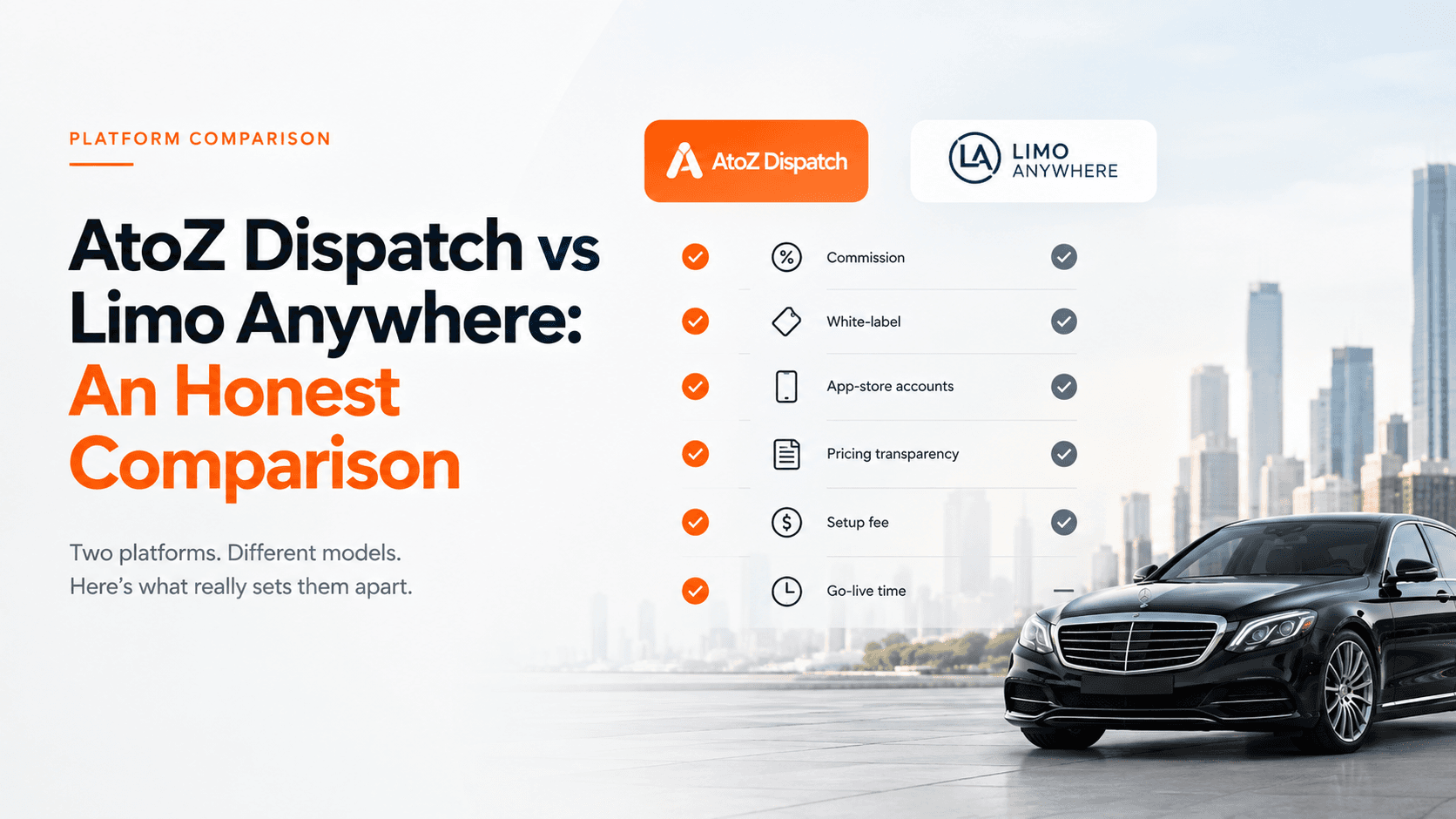
Pricing transparency. Can you understand the bill in plain language? If their pricing page makes you nervous about hidden fees, trust that instinct.
Total monthly cost. Not the base fee. The total. Including per-booking fees if any. Be specific. Ask them: "If I run 500 bookings next month, what is my exact bill?"
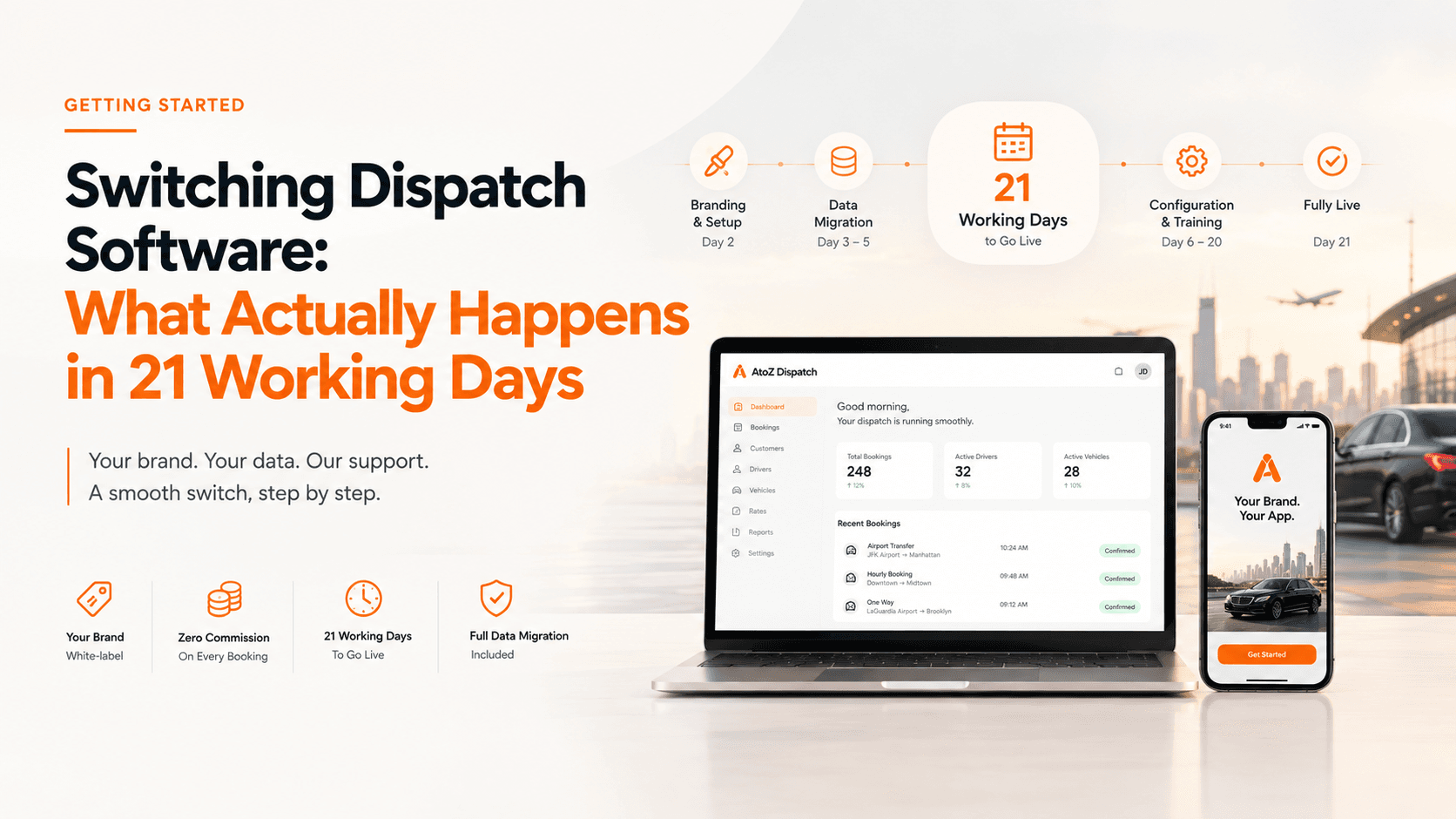
Migration help. If you're switching from another platform, do they move your data for free or charge you a fee? A good vendor moves you for free because they want your business. A bad one charges you $500-$2000 for "implementation."
Contract terms. Month to month or annual? Cancel anytime or locked in?
Real support. Email someone with a question. Do they respond same-day? Is it a real person or a template? Try the chat function. Is it a bot?
White-label or not. Will customers download YOUR app, or the vendor's app with your name on it as a footnote?
These six things matter more than the feature list.
Where most small operators get stuck
The trap most operators fall into is comparing vendors on feature count. Vendor A has 47 features. Vendor B has 62. So B must be better.
But you don't use 62 features. You probably use 12. And the 12 you use are the same 12 across every vendor. The differences are in the things you'll never touch.
So instead of feature counting, ask yourself this: "Will this software let me get bookings, assign cars, and get paid, without taking a cut of my fares?"
If yes, the rest is detail.
If no, doesn't matter how many features it has.
What we built at AtoZ Dispatch
I won't pretend this isn't a pitch for our product, but I'll be specific so you can compare.
We charge $25 a month flat. That's the only plan. No tiers, no add-ons, no per-booking fees, no commission on fares.
You get all four core pieces (dispatcher console, driver app, customer booking, payment processing). Plus white-label passenger app, flight tracking, multi-zone pricing, corporate billing, and full data migration from any other system.
Month to month. Cancel anytime. 14-day free trial with no card required.
We've been doing this since 2006. Mostly serving operators with 1-100 vehicles.
If you want to test it, the free trial is at atozdispatch.com/try-for-free.
If you want to see it in 10 minutes, watch the quick demo at atozdispatch.com/quick-demonstration.
If you want to talk to us first, call (866) 428-0245 or book a 15-minute demo at atozdispatch.com/book-demo.