AI Employee vs Hiring Office Staff
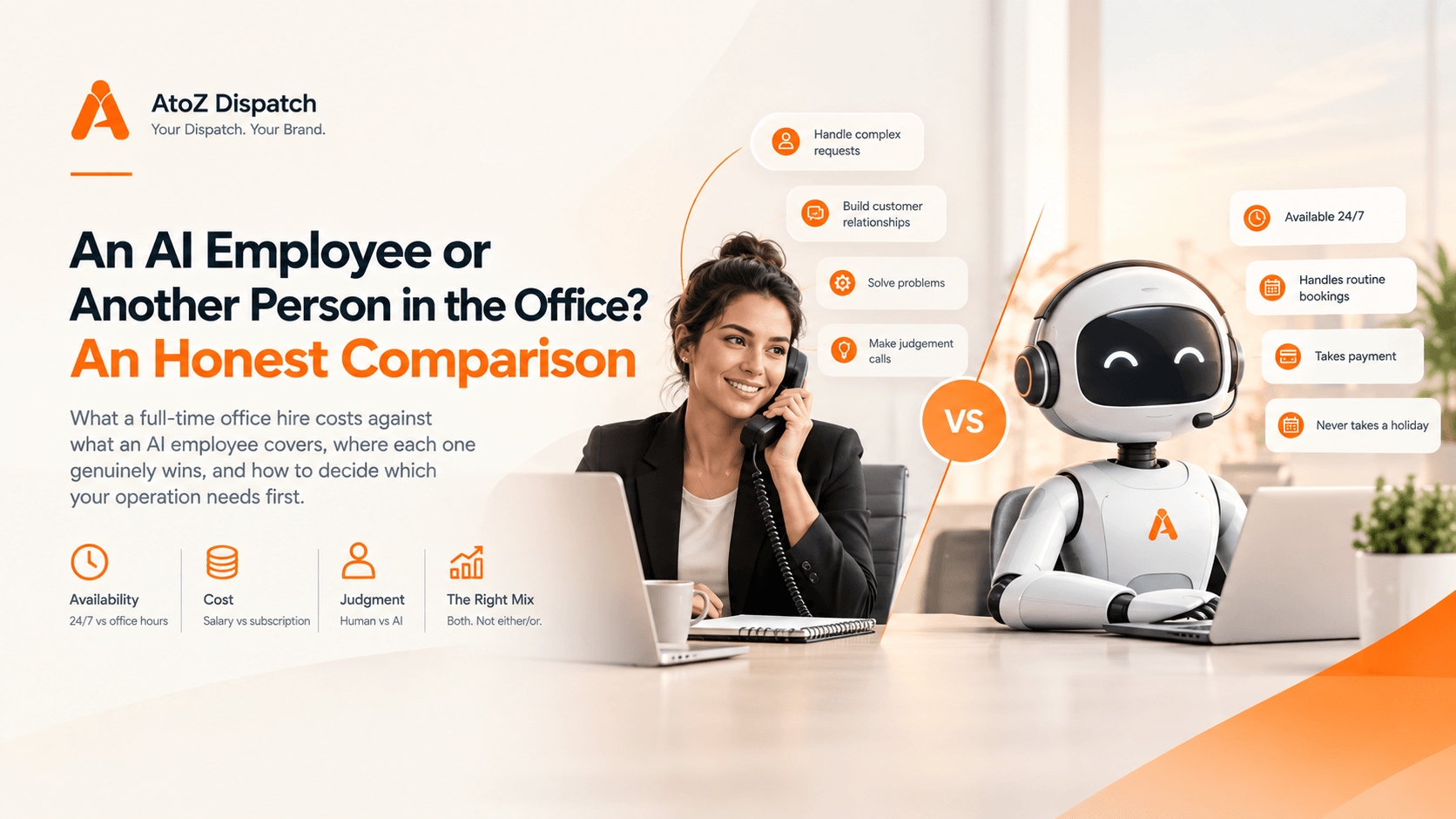
An AI Employee or Another Person in the Office? An Honest Comparison
It depends on the hours you need covered. A full-time office hire covers roughly forty hours a week and costs a salary plus employment overheads. An AI employee covers the hours nobody is covering — evenings, weekends and while you are driving — at a subscription cost. Most operators are not choosing between them; they are covering a gap a hire would not fill economically.
Key points
- The honest comparison is not cost per hour. It is what each one is good at.
- A person handles judgement, complaints, exceptions and relationships. Keep those with a person.
- An AI employee handles routine bookings during hours nobody is covering.
- A full-time hire for a phone that rings a handful of times a day is a hard sum to make work.
- A part-time hire leaves the same gap at the same hours — usually the busiest ones.
- Most operators end up with both, doing different work.
This comparison is usually written to make the software win. It should not be.
There is work a person does that no AI employee should be handed, and knowing where that line sits is the whole decision. Get it wrong in one direction and you pay a salary to handle calls that did not need a human. Get it wrong in the other and you put software in front of a customer who needed judgment.
So: what the hire gives you first, then the cost case, then how to tell which you need.
What a person gives you that software does not
Judgment in an unfamiliar situation. A flight has been diverted, the client is stranded at a different airport, and there is a decision to make about whether to send a car three hours on spec. A person weighs what they know about that client and decides. Software should not be making that call.
Relationships. The corporate booker who rings your office and asks for someone by name. Twenty seconds of conversation about their week before the booking. That is not overhead — it is the reason the account stays with you when a competitor quotes ten per cent under.
The difficult conversation. A complaint, a refund, a driver who let someone down. These need someone who can apologise properly and make a decision about putting it right. Automating them is how businesses lose customers politely.
Everything you have not thought of. A new person can be told what to do about a situation nobody anticipated. That flexibility is worth more than it looks on an org chart.
None of that is a limitation of any particular software. It is a description of what the work actually is.
What an office hire costs
The salary is not the cost. Employer costs sit on top of it, and they are substantial and published.
In the United Kingdom, employer National Insurance contributions and the minimum pension contribution are set by HMRC; current rates are on gov.uk. In the United States, the employer's share of Social Security and Medicare is 7.65% under FICA, published by the IRS, with federal and state unemployment tax on top. Rates change, so check the current figures for your jurisdiction rather than relying on a number in a blog post.
Beyond the statutory costs sit the ones that do not appear on a payslip:
- Recruitment — advertising, and your own hours interviewing
- Training — weeks before a new person is quoting confidently and unsupervised
- Cover — holidays, sickness, notice periods. A single hire covering your phone means the phone is uncovered whenever they are not there
- Equipment and space — a desk, a computer, a phone line
The honest way to do this sum is to take the salary you would actually offer, add your jurisdiction's employer costs, and then ask what happens to the phone during four weeks of annual leave.
What an AI employee covers
A narrower job, done without a rota.
The routine inbound call: someone wants a car, gives a pickup and a destination and a time, wants a price, wants to pay. That call has a shape, and it is the same shape at nine in the morning and eleven at night. It is also, for most small operators, the large majority of calls.
It answers every one. Quotes from your rate card. Takes payment. Confirms. Puts the booking on the board. Follows up afterwards. It does not take holidays and it does not need cover, because there is no rota to cover.
What it does not do is any of the four things in the first section. When it reaches one, it hands over to a person.
Side by side
AI employeeOffice hireAvailabilityEvery hour, including nights and weekendsContracted hours, minus holiday and sicknessCost basisFixed monthly, does not vary with call volumeSalary plus employer costs, rising with hoursTime to productiveLoaded with your rates and procedures before go-liveWeeks of training and supervisionJudgment on the unexpectedHands over to a personYes, and improves with experienceRelationshipsNoYes, and this is the point of the roleScaling to a busy nightHandles concurrent callsOne call at a timeDifficult conversationsEscalatesYes
Read the rows rather than counting them. Two of them decide most cases: availability and judgment on the unexpected. Which of those is your actual problem?
The realistic answer for most small operators
It is not either/or, and any vendor telling you it is has an interest in the answer.
An AI employee does not replace your staff. What it does is take the routine calls that arrive when nobody is free — the ones currently going to voicemail or to a competitor — so that the people you employ spend their time on the work that needs a person.
For an owner-driver with no office staff, it is not a comparison at all. The realistic alternative to an AI employee is not a hire; it is the phone continuing to ring unanswered while you are on a job. That is the position most single-vehicle and two-vehicle operators are actually in.
For an operation that already has someone on the phone, the question is different: is that person spending their day on routine bookings that could be handled, so they can do the account work and the difficult calls instead?
A short diagnostic
Four questions. Answer them about last month, not about how it usually is.
1. How many calls went unanswered, and when? If your phone system does not tell you, that is worth finding out before you spend money on either option. If most of the misses are outside office hours, a hire does not fix them.
2. What proportion of answered calls were routine bookings? Pickup, destination, time, price, pay. If it is most of them, the routine work is the bottleneck.
3. What do you currently lose to the unanswered ones? Take your average fare and multiply. Rough is fine — the order of magnitude is what decides this.
4. Is there work only a person can do that is not getting done? Chasing corporate accounts, following up quotes, handling complaints properly. If yes, you may need the hire regardless, and the AI employee is what frees them up to do it.
If the misses are mostly out of hours and mostly routine, start with the AI employee. If question four is your loudest answer, hire, and consider the software as the thing that makes the hire worthwhile rather than an alternative to it.
Frequently asked questions
Q: Is an AI employee cheaper than hiring office staff?
A: For covering evenings, weekends and the hours you are driving, usually yes — a full-time hire for a phone that rings a handful of times a day is difficult to justify. For judgement work and relationships, a person is worth more.
Q: Should I replace my office staff with it?
A: No, and we would not recommend it. The common pattern is both, doing different work: the person handles exceptions and relationships, the AI handles routine bookings out of hours.
Q: What is a person still better at?
A: Complaints, unusual requests, negotiating with a corporate client, and anything where the right answer depends on judgement rather than rules.
Q: How do I work out whether it is worth it for me?
A: Count the calls you currently miss in a week and multiply by your average fare and conversion. Compare that to the subscription, not to a salary.