Your Network vs Their Marketplace

Your Network or Their Marketplace: Who Owns the Relationship?
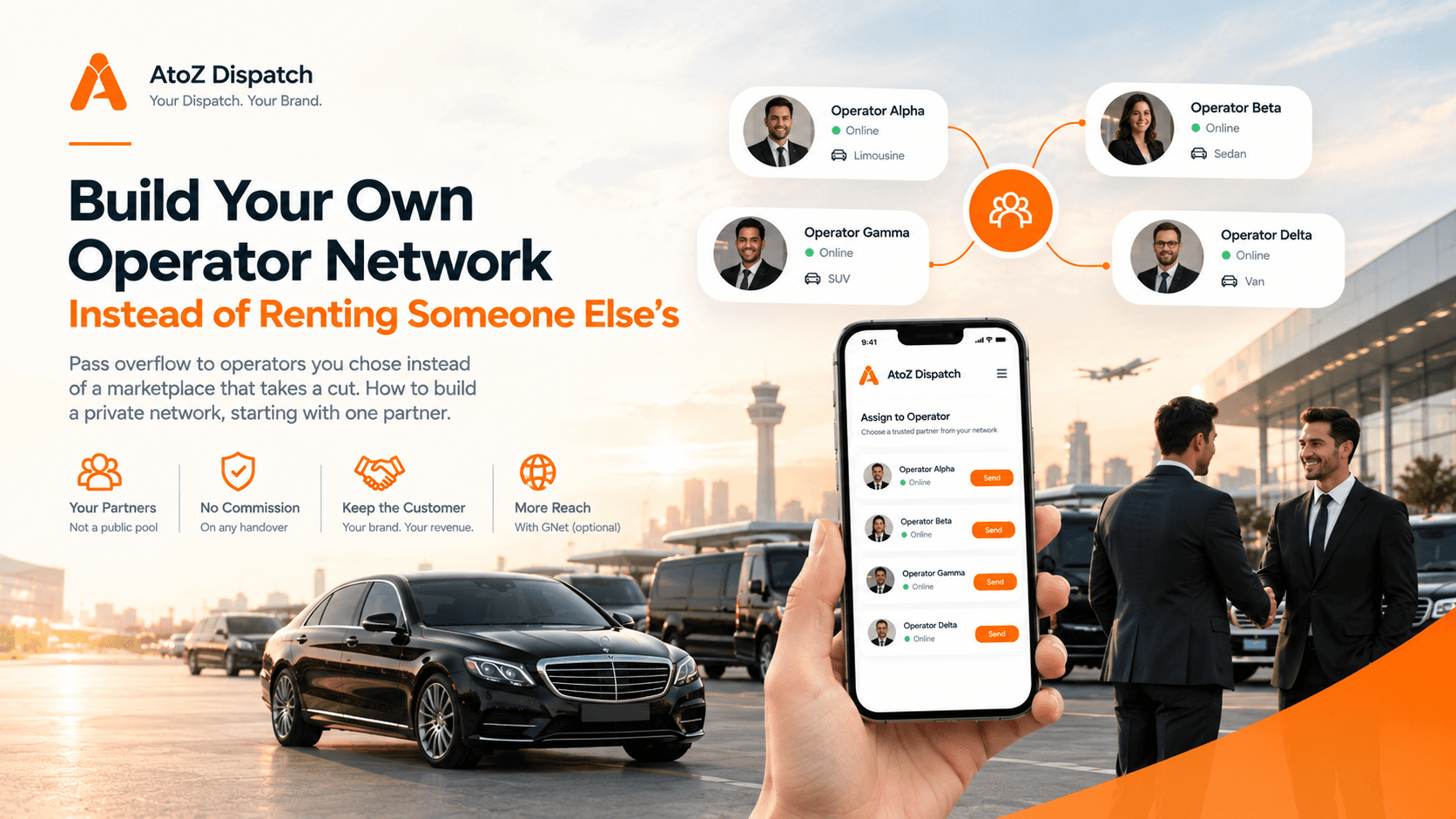
A marketplace is a public pool that matches your job to whoever is available and takes a percentage of it. An operator network is a private group you invite yourself, where work moves between companies you chose and no commission is taken. The difference that matters is not the percentage — it is who owns the customer relationship afterwards.
Key points
- Both have a place. This is about the balance, not a verdict.
- Marketplaces give real reach, and charge for it per job.
- Your own network gives you accountable partners, and charges nothing per job.
- The long-term cost of a marketplace is not the fee. It is the relationship.
- Route the long tail through a marketplace; keep repeat and corporate work in your network.
There is a version of this argument that is just a complaint about commission. That version is not very useful, because the percentage is the smallest part of what is happening.
Who this is for
Operators deciding how much of their work should flow through someone else's platform. Which, increasingly, is all of them.
What a marketplace is genuinely good at
Start with the honest part, because a comparison that pretends the alternative has no merit is not worth reading.
A large marketplace has reach that you, individually, cannot build. It can find a car in a city you have never worked in, at 4am, for a client who booked you and now needs covering. It has scale, redundancy, and a pool deep enough that something is almost always available.
If you tried to build that yourself, it would take a decade and you would still have gaps. On the morning you are genuinely stuck, that reach is worth paying for.
What it costs beyond the percentage
The fee is visible. Three other costs are not.
Selection. The company that turns up was chosen by an algorithm optimising for the platform's fill rate, not by you optimising for your client.
Standards. You inherit whatever that operator's standards are. Your client experiences them as yours.
The relationship. This is the one. Every job routed through a platform is a job where the platform sits between you and the customer, gathers the data about it, and gets a little more useful to that customer than you did.
Do it occasionally and it is a tool. Do it with most of your overflow, for years, and the platform becomes the party the customer actually has a relationship with. You become a supplier to your own demand.
What a private network is good at
You invite the companies. You have met them, or worked with them, or been recommended them by someone whose judgement you trust.
Selection is yours. You are choosing for your client, not for a fill rate.
Accountability is direct. If a partner lets you down there is a person to ring, and they care what you think, because they want the next job.
Nothing is taken. AtoZ charges a subscription for the software and takes no commission on any booking — including work you pass to a partner. What you and the partner settle is between the two of you.
The customer stays yours. They booked you, their record is in your system, and everything they see carries your brand.
The limit is real and worth stating: your network only covers what your network covers. On day one that is nobody. Building it is work.
The question that actually decides it
Not "what is the commission?" but:
In two years, whose customer is this?
If most of your work flows through your own board, to your own drivers and partners you chose, the answer is you. Your brand is on the booking, the app and the invoice, and your record of that customer is complete.
If most of it flows through a platform, the answer drifts. Slowly, and then not slowly.
A sensible balance
Nobody sensible refuses to use a marketplace. The balance most operators land on:
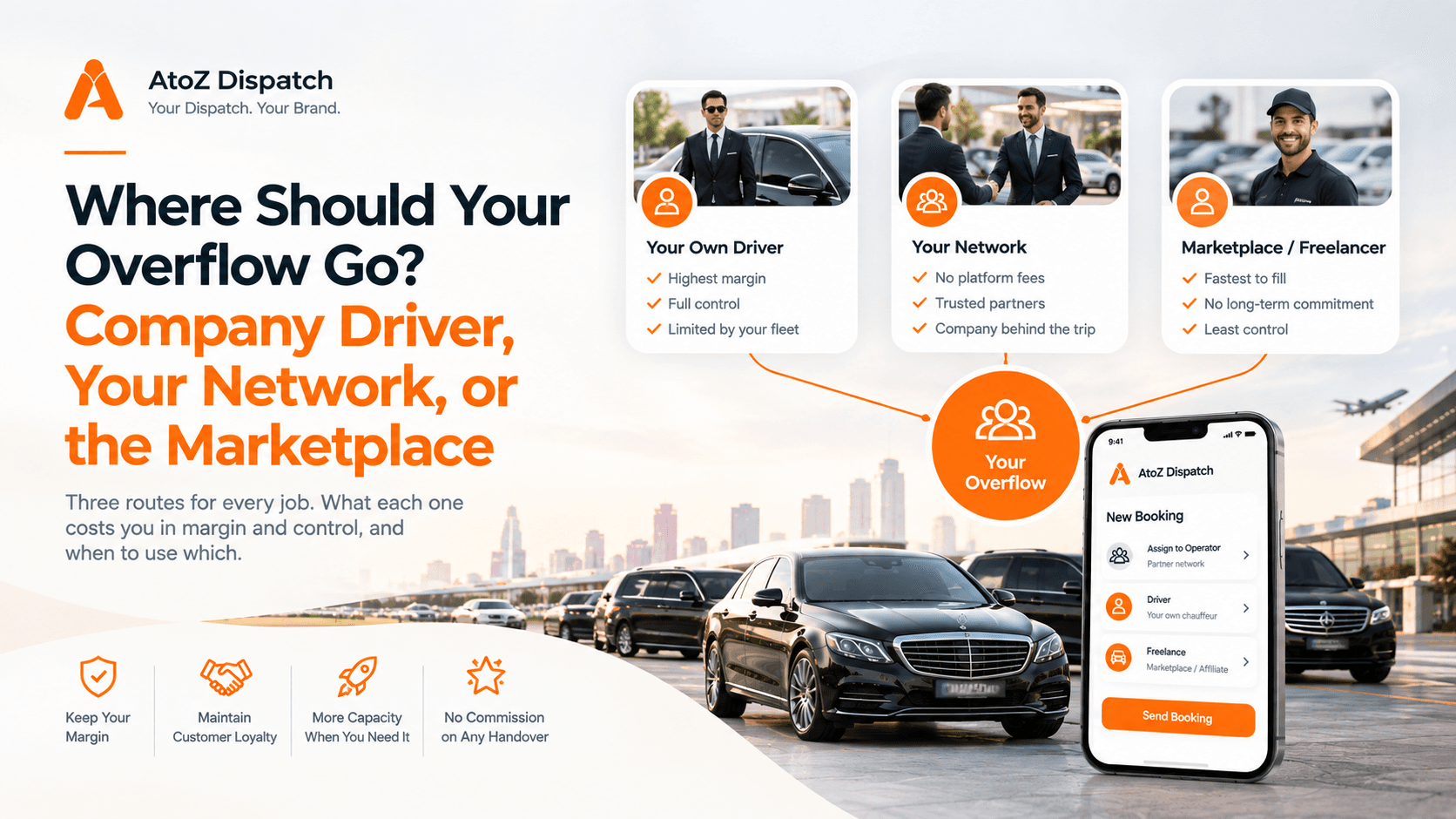
Your own drivers first. Best margin, best control.
Your operator network second. Partners you chose, no cut taken, real accountability.
A marketplace last, for the genuine long tail — the city where you have nobody and no prospect of anybody.
The mistake is not using marketplaces. It is letting the last resort quietly become the default, because it was easier than building the second option.
Where the software sits in this
Two things decide whether you can hold that balance.
Zero commission. If your platform takes a percentage of every booking, then your platform's income grows with your revenue and it has no reason to help you route work around it. AtoZ charges a flat monthly subscription and takes nothing per booking, which is why we can write an article telling you to build a network we are not in the middle of.
White label. The booking site, the passenger app and the driver app all carry your logo, your colours, your domain and your own app-store accounts. Your customer downloads your app. They never see our name, which means the relationship they build is with you.
How to start with AtoZ
Start by moving one thing: take the next overflow job you would have posted to a marketplace and give it to a company you know instead. That is your network, on day one.
If you are choosing a platform: Team 5 is $149 a month with a $499 one-time setup, Team 25 is $299 with $699, Team 50 is $399 with $799. Team 25 is the common choice. Setup, onboarding, migration, unlimited vehicles and unlimited reservations are included, and there is no commission on any booking.
We name the setup fee up front rather than leaving you to discover it. Team plans go fully live in 21 working days.
Book a demo at atozdispatch.com/book-demo, or call, text or WhatsApp 302 499 1612.
Working with operators since 2006. Your brand, your rules, your revenue.
Frequently asked questions
Q: What is the difference between an operator network and a marketplace?
A: A marketplace is a public pool that matches your job to whoever is available and takes a percentage. An operator network is private and invitation-only: you choose every partner, work moves by direct assignment, and no commission is taken on the handover.
Q: Is using a marketplace a mistake?
A: No. Marketplaces have genuine reach and are the right tool for a job in a city where you have no driver and no partner. The mistake is routing your repeat work and your best clients through one.
Q: Who owns the customer on a marketplace booking?
A: It varies by platform, but the direction of travel is consistent: the more of your work that flows through a platform, the more the customer associates the service with that platform rather than with you.
Q: Does AtoZ take a commission?
A: No. AtoZ charges a monthly subscription for the software and takes no commission on any booking, ever.
Q: How do I keep my brand in front of the customer?
A: Use white-label software. On AtoZ the booking site, the passenger app and the driver app all carry your logo, your colours, your domain and your own app-store accounts. The passenger never sees our name.