You Do the Work. Who Keeps the Customer?
On a marketplace app, your service wins the customer — but the platform keeps them. Owning your customer database changes what happens after the trip ends, and it is a smaller change to make than most operators expect. Your clean car. Your route, chosen because you know the road works on that stretch. Your service — from the door held open to the bottle of water in the seat pocket. The passenger had a good trip and said so. And then the platform kept their number, their card details, and their next booking. You got one fare.
The Trade Nobody Spells Out
When you sign up to a booking marketplace, the deal looks straightforward: they send you work, and you pay them a percentage. What is rarely stated is the second half of the exchange:
You do the work; they acquire the customer. That is not a loophole. It is the business model, and from the platform's side, it makes sense. The platform spends money on advertising to win a passenger. It needs that passenger to come back through its app rather than book directly with you. From its perspective, the passenger belongs to the app because the app paid to acquire them. The trouble is that you paid for that customer too. You paid in fuel, in the hour you spent on the job, in vehicle wear and maintenance, and in the standard of service that made the passenger want to book again. You just do not have anything to show for it afterwards.
What You Actually Own Today
Take an inventory of a typical small operation. You own the vehicle, or you are financing it. You own your licences and insurance. You carry the fuel bill, maintenance costs, and cleaning expenses. You own your time. Now look at your customer records. If most of your work comes through an app, the honest answer for many operators is that there are none. You could not send a message to last month's passengers if you wanted to, because you have never had their contact details. You have a payments statement, not a customer list.
That matters most at the moment you least want to think about it:
- The platform changes its commission.
- A competitor undercuts you on the same app.
- Booking volume starts to dry up.
- Your operating costs increase.
- You decide you want more direct bookings.
A business with a customer list has somewhere to go.
A business without one starts again.
What Owning the Database Means in Practice
A white-label system changes the arrangement.
Every booking taken through your website, your app, or your phone line can save the customer into your own system — including their name, contact details, addresses, trip history, and preferences.
With AtoZ Dispatch, the relationship stays between you and your passenger.
AtoZ Dispatch does not sit between you and that passenger. We do not market to your list, sell them another operator's service, or contact them.
We are a technology provider.
The database is yours in the ordinary sense of the word: it is your property, held within your account.
What Can You Do With Your Customer Data?
The practical benefits are simple, but they add up quickly.
You can:
- See that a passenger has booked eleven times and treat them accordingly.
- Email corporate accounts about a new vehicle class.
- Identify which airport routes generate repeat business.
- Understand which customers book regularly and which do not.
- Build relationships with passengers who already know and trust your service.
- Encourage direct bookings instead of relying entirely on third-party marketplaces.
None of that is possible when the customer relationship lives on somebody else's platform.
And You Can Leave With It
This is the part worth reading twice.
Can you take your customer database with you if you leave?
With AtoZ Dispatch, you can export your customer database to CSV or Excel at any time and take it with you.
There is:
- No lock-in clause.
- No export fee.
- No requirement to ask permission.
If you decide in a year that AtoZ is not right for your business, you leave with the list you built.
That matters.
A vendor who owns your customers has a reason to make leaving difficult.
A vendor who does not own them has no such reason — and can afford to say so plainly.
The Three Reasons Operators Actually Switch
In conversations with operators moving away from marketplaces or older systems, the reason is almost always one of three things.
It is worth knowing which one is yours before you start comparing software.
1. Commission
The percentage is the visible cost, and for a busy operator, it compounds.
If commission is your biggest concern, the question to ask any vendor is simple:
What do you take from each booking?
A platform that charges a percentage of every reservation can become significantly more expensive as your booking volume grows.
2. Not Owning the Relationship
You are doing the work of building a reputation, while somebody else is banking the customer relationship.
Colin McNeill, who runs Trident, made a related point publicly on Trustpilot about AtoZ's pricing: one rate rather than a charge that climbs with every driver you add.
The underlying concern is similar — a cost or claim on your business that grows as you grow.
When you build your own customer database, every successful trip has the potential to strengthen your business rather than someone else's platform.
3. Admin Time
The phone.
The diary.
The confirmations.
The invoices.
The follow-ups.
The dispatching.
If admin time is your biggest problem, dispatch software is only half the answer. You should also ask how much of the process the system can automate and how much work your team will still have to do manually.
Most operators will say all three matter when asked.
But usually, one of them is the reason they picked up the phone.
Knowing which one matters most changes what you should be looking for.
Three Questions Worth Asking Before You Move Anything
Whether you end up choosing AtoZ Dispatch or another system, these three questions can help separate a platform that hands you the customer relationship from one that simply borrows it.
1. Who Does the Passenger Think They Booked?
Look at the:
- Confirmation email
- SMS
- Booking page
- App
- Customer communications
If they carry the vendor's name instead of yours, the passenger is learning the vendor's brand — not yours.
2. Can I Export the Customer List Today Without Asking?
Do not simply ask:
"Is there an export feature?"
Ask:
"Can I press the button myself today and get a usable file?"
There is a big difference.
A vendor who has to arrange the export for you has made a choice about who controls the list.
3. Does the Platform Ever Contact My Customers?
Ask directly.
Does it send:
- Marketing emails?
- App notifications?
- Promotional offers?
- Offers for another operator?
- Re-engagement messages?
And if customer ownership matters to you, ask for the answer in writing.
These questions take five minutes to ask, but the answers can tell you more about the next three years of your business than a feature list ever will.
What Starting Actually Looks Like
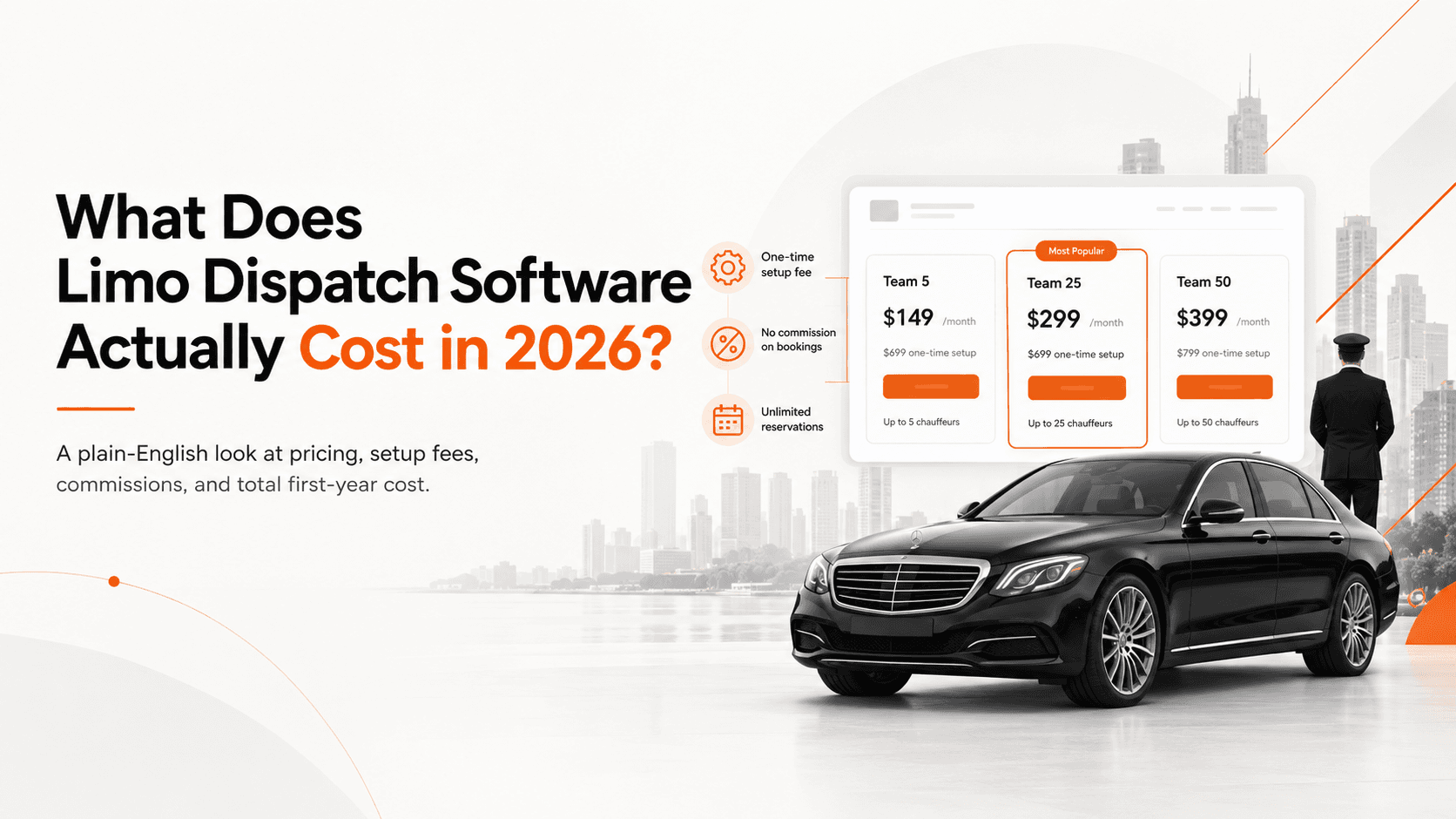
AtoZ Dispatch plans are designed around the size of your fleet rather than a sales conversation.
PlanMonthly PriceOne-Time SetupChauffeurs
Team 5 $149/month $499Up to 5
Team 25 $299/month $699Up to 25
Team 50 $399/month $799Up to 50
Above 50 Contact usContact usCustom
Every Plan Includes
- Setup
- Onboarding
- Migration of your existing data
- Unlimited vehicles
- Unlimited reservations
- No commission on bookings
A Team plan can be fully live in 21 working days.
Start With a Demo — Not a Signup Form
The next step does not have to be a signup form.
It is a demo, run using your own rates and your own zones, so you can see what your business actually looks like inside the system before making a decision.
You get to see the workflow, understand how the system fits your operation, and decide whether it makes sense for you.
If it is not right, you will know within the half hour.
And that is a useful outcome too.
Ready to See What Your Business Could Look Like?
Book a demo with AtoZ Dispatch and see the system using your own rates, zones, and requirements.

Written by the A to Z Dispatch team
We build white-label dispatch software and AI employees for limo, taxi, chauffeur and airport transfer businesses. About us