What Is an AI Employee
An AI employee is software that completes a job in your business from start to finish, rather than answering a question and stopping. For a limo, taxi, or chauffeur operator, that means it answers the phone, takes the pickup and destination, quotes the fare from your own rate table, sends a payment link, confirms the trip, and follows up afterwards. It is not a chatbot on your website. It is not a general automation tool.
That distinction is the whole subject of this guide, because the word "AI" is currently being used for two products that behave nothing alike.
The problem it solves
Picture a normal Tuesday. You are on a job with a client in the back. The phone rings. You cannot answer it. Not because you do not want the work, but because you have a passenger two feet behind you and a junction coming up. By the time you are free, the caller has rung the next company on their list and one of them picked up. You will never know that booking existed. There is no missed-call notification for a customer who found somebody else. This is the position most small operators are in for most of the working day. One or two vehicles, no dispatcher, no receptionist, and the owner driving. The phone is the front door of the business, and it is unattended during exactly the hours the business is busiest.
Hiring someone to sit by it is the obvious answer, and for some operations it is the right one. But a full-time hire to cover a phone that rings a handful of times a day is a hard sum to make work, and a part-time hire leaves the same gap at the same hours.
What an AI employee actually does
Take the call above. Here is the same call with an AI employee answering it. The caller says they need a car to the airport on Thursday at six. The AI asks for the pickup address and confirms the destination and the time. It calculates the fare using your rate card — your zones, your fixed airport price, your vehicle classes, your surcharges. It sends a payment link. The customer pays. The booking is confirmed and lands on your dispatch board. You find out when you are next free, and it is already done.
Afterwards, the same set of employees can send the reminder the night before, the receipt after the trip, and the review request a day later. Those are three jobs almost every small operator intends to do and almost none of them are consistent, because they lose every time to the next booking coming in.
What it is not
**It is not a chatbot.** A chatbot answers a question. Somebody types "do you do airport transfers?" and it says yes. That is genuinely useful — it saves you an email. But the customer still has to contact you to actually book, so the work comes back to your desk. Nothing has been completed. **It is not general-purpose automation.** Automation tools connect apps and move data between them. An AI employee holds a conversation with a customer and reaches an outcome. The test is simple. At the end of the interaction, does a confirmed booking exist? If not, you have bought something else — possibly something worth having, but not this.
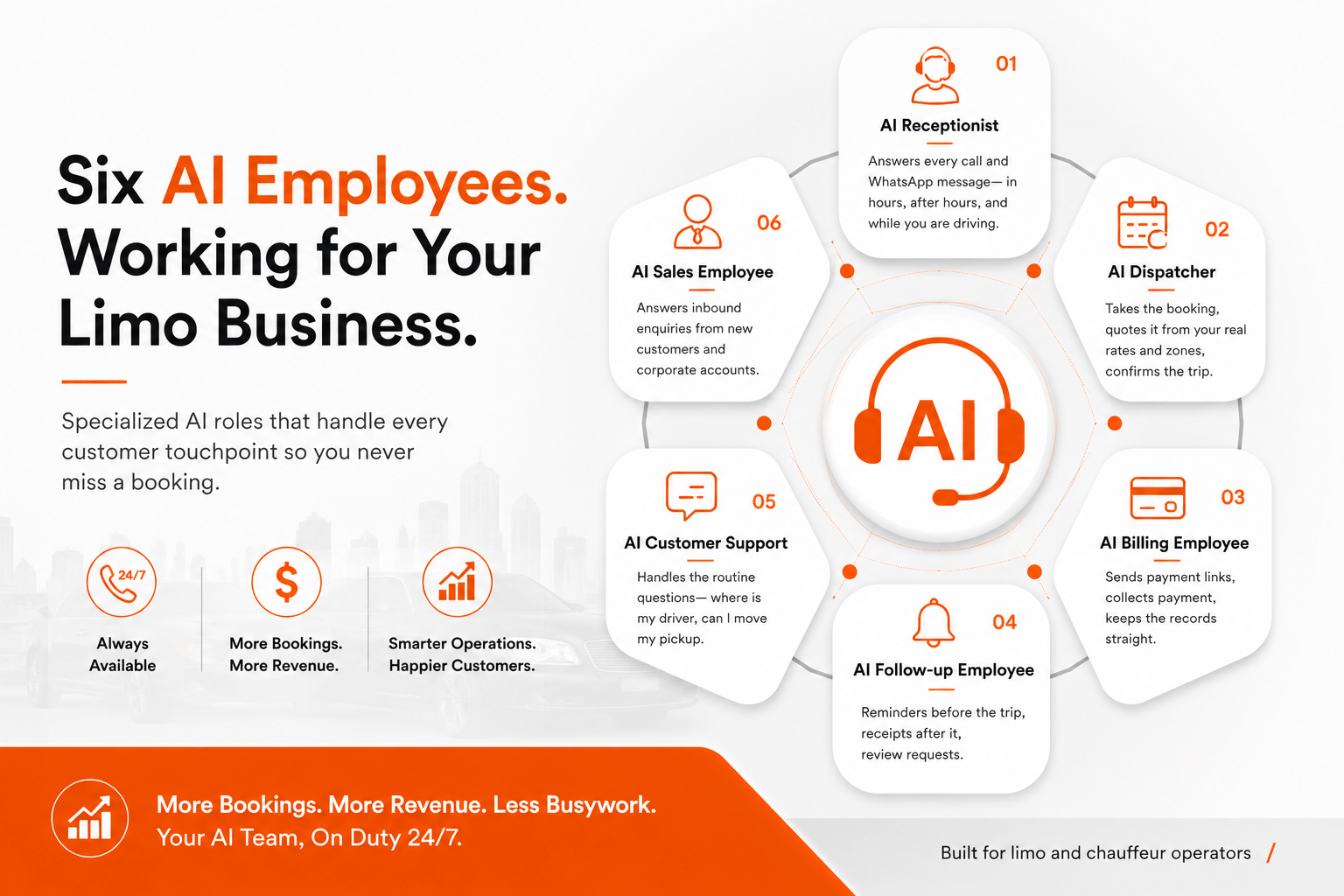
The Six AI Roles
- AI Receptionist
- Answers every call and WhatsApp message.
- Works during business hours, after hours, and while you are driving.
- AI Dispatcher
- Takes bookings.
- Quotes trips using your real rates and zones.
- Confirms the trip with the customer.
- AI Billing Employee
- Sends payment links.
- Collects payments.
- Keeps billing records organized.
- AI Follow-up Employee
- Sends reminders before the trip.
- Sends receipts after the trip.
- Requests customer reviews.
- AI Customer Support
- Handles routine customer questions.
- Provides driver location updates.
- Handles pickup time or location changes.
- AI Sales Employee
- Responds to inbound enquiries from new customers.
- Handles enquiries from corporate accounts.
Where to start: Most operators start with one role, usually the AI Receptionist, because that is where lost revenue is easiest to see.
How it is trained on your business
This is the part that decides whether the whole thing is useful or annoying. Before any of it goes live, the AI employees are configured with your actual operating details: your rates, your service zones, your vehicle types, your payment methods and your procedures. That matters because a generic quote is worse than no quote. If a caller is told a price that is not yours, you have to correct it — in front of the customer, after they have already decided what the trip costs. You would rather have missed the call. Your fares are not simple, and they should not have to be. Fixed prices for airport runs. Distance-based pricing with a minimum fare for city work. Hourly for weddings and as-directed jobs. Zone-to-zone rates for the routes you run constantly. Waiting time charged differently for airport pickups than for a regular collection. Child seats. Peak, holiday and night rates on their own windows.
An AI employee quotes from that rate card, not from an estimate. When it says a number, it is your number.
What it does not do
It does not replace your dispatcher, and any vendor who tells you otherwise is selling you a disappointment. Judgment work stays with a person. The corporate client whose flight has just been cancelled and who needs three cars re-timed. The regular who wants the same driver every week and will notice if he does not get him. The passenger who is upset and needs to hear a human being take responsibility. Hand any of those to software and you will lose the account. What an AI employee takes off you is the other conversation. The one that is the same every
single time: pickup, destination, date, time, quote, payment, confirmation. For most small operators that is the bulk of the phone traffic, and it is the part that a skilled person should not be spending their day on. We would rather tell you where the line sits than let you discover it in week two.
Who it is for
Any transportation business without a full office team — limo, taxi, chauffeur, airport transfer, corporate transportation. A solo operator uses it to cover the phone while driving. A larger fleet uses it to take the routine calls and the routine support, so the dispatchers on the payroll spend their time on the jobs that actually need judgment. If you already have an office team who answer every call inside three rings and never miss one after six, you may not need this. Most operators we speak to are not in that position.
Frequently Asked Questions
Q: Does an AI employee replace my dispatcher?
A: No. Judgment calls — a VIP client, an unusual request, a real problem — still go to a person. It handles the routine calls, which for most operators are the majority of the phone traffic.
Q: How does it know what to charge?
A: Your rate card is loaded in before it goes live: your zones, fixed fares, per-mile and hourly rates, waiting charges, and surcharges. It quotes your prices, not an estimate.
Q: Does it work on WhatsApp as well as the phone?
A: Both.
Q: Can it take payment?
A: Yes. It sends a payment link and confirms the booking once payment comes through.
Q: Is it a chatbot?
A: No. A chatbot answers a question and stops. An AI employee completes the job — the booking exists, the payment is taken, the calendar is updated, and the follow-up is scheduled.
Q: How much does it cost?
A: It depends on which roles your business needs, so any number quoted here would probably be wrong for you. A demo on your own rates gives you a real answer.
Q: How long does setup take?
A: It depends on the size of the operation, because the work is loading your rates, zones, and policies in properly. A demo will give you an honest timeline rather than a guess.
The next step
AtoZ AI is the AI workforce from AtoZ Dispatch, which builds white-label dispatch software for limousine, chauffeur, taxi and airport transfer operators. The company is Core Dream LLC in Wilmington, Delaware, and it has worked with transportation operators since 2006. The fastest way to judge whether any of this fits your business is to watch it take a booking on your own rates, with your own zones and your own prices in it. That takes about thirty minutes.
Book a demo: https://atozdispatch.com/book-demo. Slots are from tomorrow onward, in your time zone. If you would rather talk to a person first,
call, text or WhatsApp the team on 302 499 1612.