Where Should Overflow

Where Should Your Overflow Go? Company Driver, Your Network, or the Marketplace
A job you cannot cover has three possible homes — your own chauffeur, a partner operator in your network, or a freelance affiliate driver. Your own driver keeps the most margin and control. A partner operator suits work that needs a company standing behind it. A freelancer suits one-off overflow. AtoZ takes no commission on any of the three.
Key points
- The cheapest route and the route that keeps the customer are rarely the same one.
- Own chauffeur: most margin, most control, capped by your fleet.
- Partner operator: a company you chose is accountable for the trip.
- Freelance affiliate: fastest to fill, least control.
- Three ways to reach a freelancer: assign directly, auto-dispatch, or broadcast.
Every job you cannot drive yourself has to go somewhere. Most operators decide that in about four seconds, under pressure, and the decision is worth more thought than it usually gets.
Who this is for
Anyone dispatching more work than their own vehicles can cover — which is most operators on most good weeks.
Route one: your own chauffeur
Pick the chauffeur and the vehicle from your own fleet and assign the job.
Margin: highest. The fare is yours, minus your driver's cost.
Control: total. Your car, your driver, your standards.
Limit: your fleet. This route runs out precisely when business is best.
Use it for: anything you can cover. This is the default and the other two exist because it runs out.
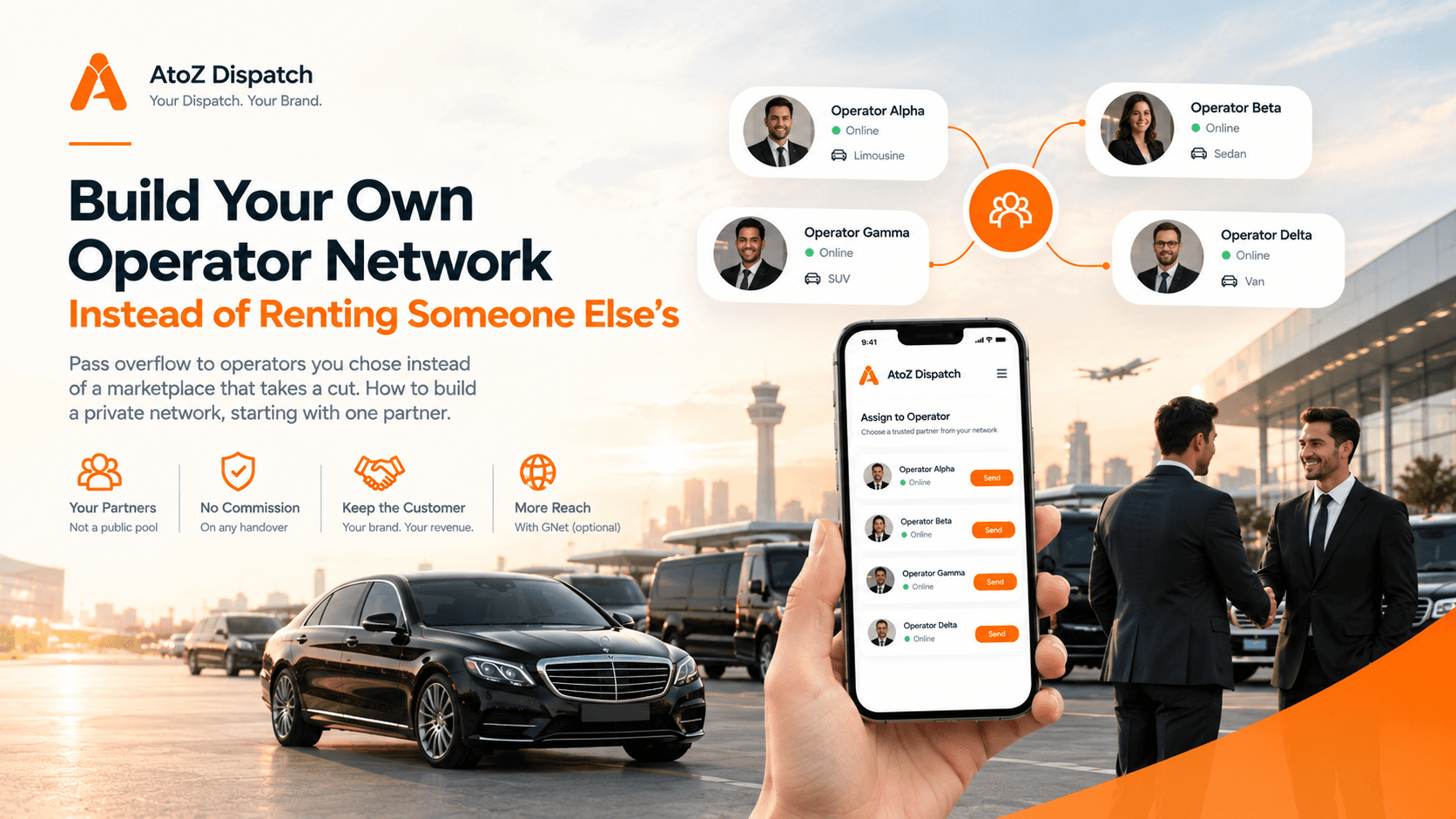
Route two: a partner operator in your network
Assign the booking to a company in the operator network you have built. They dispatch it to their own drivers.
Margin: whatever you and the partner agreed. No platform fee — AtoZ takes no commission.
Control: high, but indirect. You do not pick the driver; you picked the company, and they are accountable to you for it.
Limit: the size of your network, and whether your partner has capacity that day.
Use it for: work where a failure costs you the client. Corporate accounts. Weddings. The account client's chairman. A company has depth a lone freelancer does not — if their first driver falls over, they have a second.
Route three: a freelance affiliate driver
An individual driver, not a company. Three ways to reach one:
Assign directly. You know the driver, you send it to them.
Auto-dispatch. The system matches on rating, distance and acceptance history, and offers it to the best fit.
Broadcast. Send it out and the first driver to accept takes it.
Margin: whatever you agreed with the driver. Again, no commission to us.
Control: lowest of the three, especially on broadcast, where speed is the whole point.
Limit: an individual is one person. If they cancel, you are back where you started.
Use it for: one-off overflow where filling the job quickly matters more than knowing exactly who fills it.
The decision, in one line each
RouteMarginControlBest forWatch out forYour own chauffeurHighestTotalAnything you can coverRuns out exactly when you are busiestPartner operatorYour agreement, no platform cutHigh, via the companyCorporate, weddings, high-stakesNeeds a network built in advanceFreelance affiliateYour agreement, no platform cutLowest on broadcastOne-off overflow, speedAn individual has no bench
The short version: cover it yourself if you can; give it to a company when it matters; give it to a freelancer when it is a one-off.
What happens when nobody takes it
Whichever route you choose, an unaccepted job returns to you inside the response window. You take it back, send it another way, or drive it.
That is the safety net that makes delegating reasonable. A job cannot go quiet in somebody else's phone while your customer waits.
Adding people without leaving the screen
The moment you need a new affiliate is the moment you are already dispatching under pressure. New chauffeurs and new affiliates can be added inline from the dispatch screen, so you are not abandoning a half-finished booking to go and set someone up.
Where a marketplace still fits
Honestly: at the end of the list.
Public marketplaces have genuine reach, and for a job in a city where you have no driver, no partner and no realistic prospect of either, that reach is the difference between covering the trip and refusing it.
Use them for the overflow of your overflow. Not for the work that repeats, and not for the clients you cannot afford to lose — because every job you route through a marketplace is a job whose economics somebody else sets.
How to start with AtoZ
All three routes are on the dispatch board, and every one of them is commission-free. AtoZ charges a monthly subscription for the software and takes no cut of any booking, whoever runs it.
Team 5 is $149 a month with a $499 one-time setup, Team 25 is $299 with $699, and Team 50 is $399 with $799. Team 25 is the usual choice for an operator running real overflow. Setup, onboarding, migration, unlimited vehicles and unlimited reservations are included on all of them.
Everything is white-label — your logo, your domain, your app-store accounts. Team plans go fully live in 21 working days.
The clearest way to see the difference between the three routes is to watch them on a real dispatch board. Book a demo at atozdispatch.com/book-demo, or call, text or WhatsApp 302 499 1612. Working with operators since 2006.
Frequently asked questions
Q: How does dispatch software decide which driver gets a job?
A: It depends on the route you choose. You can assign a specific chauffeur or affiliate directly, let auto-dispatch match on rating, distance and acceptance history, or broadcast the job so the first driver to accept takes it.
Q: Should I give overflow to a freelancer or another operator?
A: Use a partner operator when the job needs a company behind it — corporate accounts, weddings, anything where a failure costs you the client. Use a freelancer for one-off overflow where filling it quickly matters more than control.
Q: Does it cost more to pass a job to an affiliate?
A: Not in platform fees. AtoZ takes no commission on any booking regardless of who runs it. What you pay the affiliate or partner is your own arrangement.
Q: What happens if nobody accepts the job?
A: It returns to you inside the response window. You take it back, send it elsewhere, or drive it yourself.
Q: Can I add a new driver or affiliate in the middle of dispatching?
A: Yes. New chauffeurs and affiliates can be added inline from the dispatch screen.