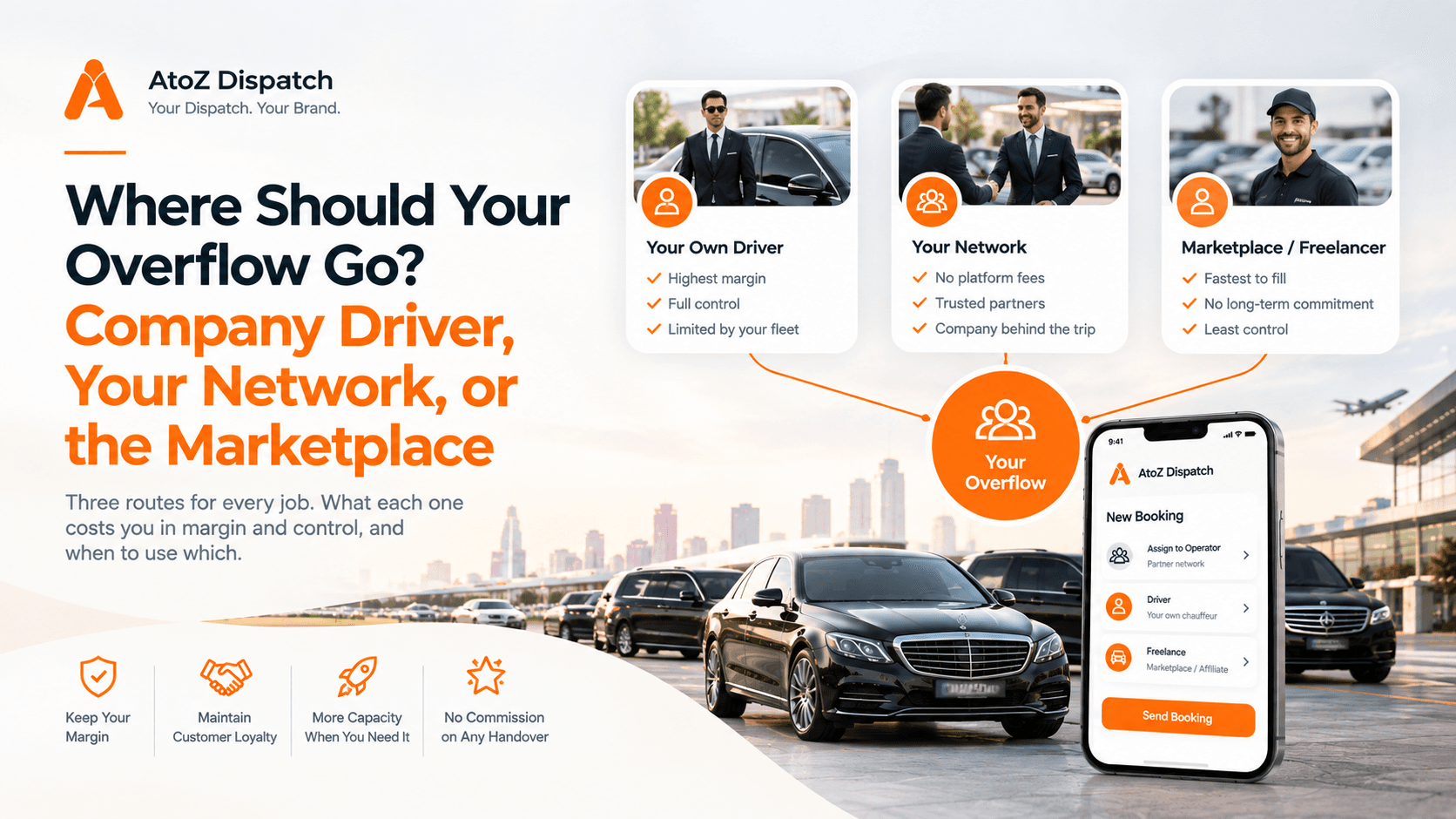
Build Your Own Operator Network
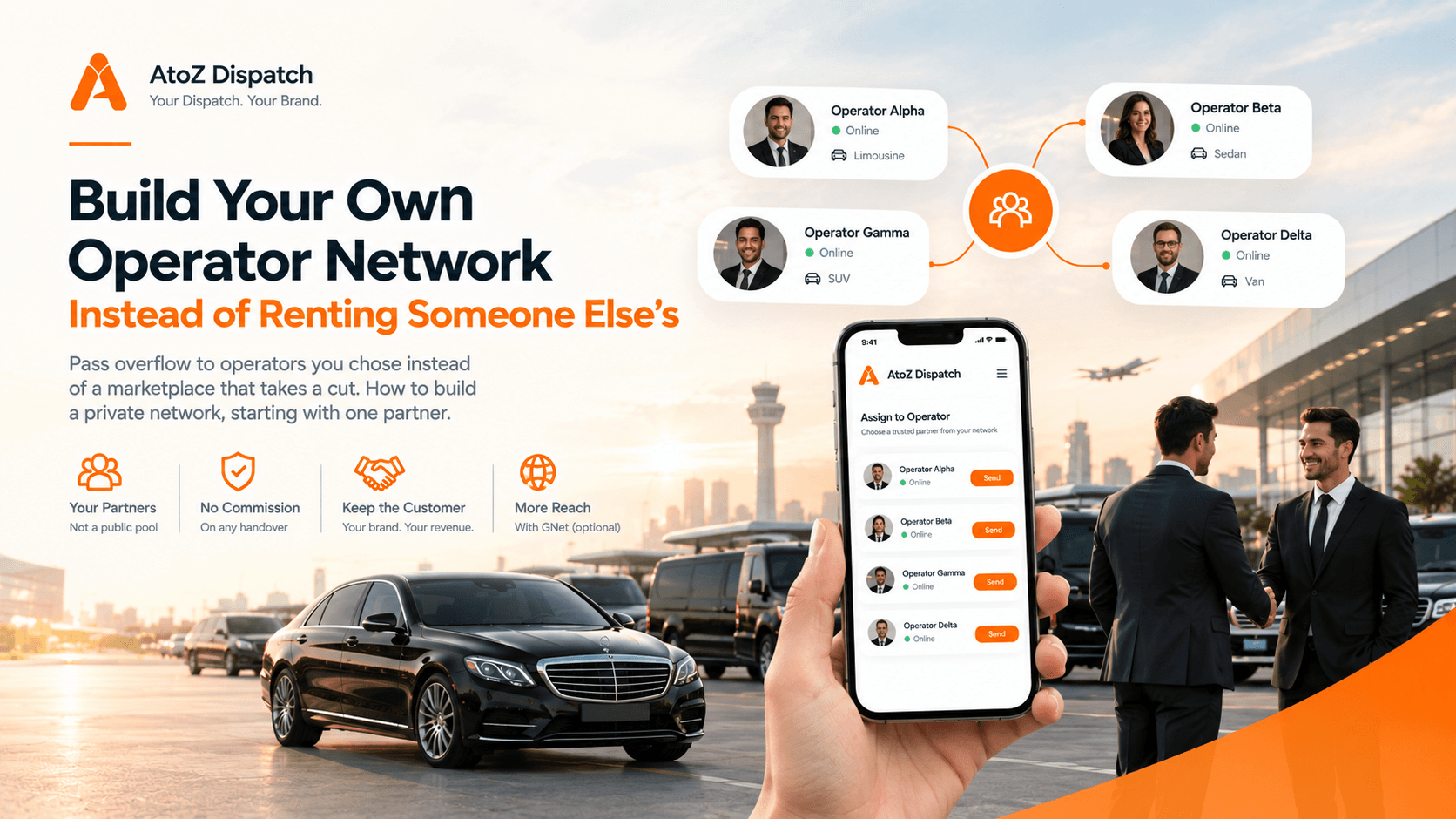
Build Your Own Operator Network Instead of Renting Someone Else's
An operator network is a private group of transport companies you invite yourself, so you can pass overflow jobs to partners you already trust instead of a public marketplace. You assign the booking to a partner operator, they dispatch it to their own drivers, and no platform takes a commission on the handover. You keep the customer.
Key points
- More work than cars is a good problem with an expensive default.
- Your network is invitation-only. You choose every company in it.
- Assign to Operator on the booking; your partner runs it with their own drivers.
- Zero commission on the handover, because there is no middleman in it.
- GNet is there for reach you cannot cover yourself — an addition, not a dependency.
If you have ever had more work than cars, you have farmed a job out. Every operator has. The question is not whether you do it, but who you do it through and what it costs you.
Who this is for
Operators with real demand and finite vehicles. If you are regularly turning away or sub-contracting work — airport runs on a busy Monday, a corporate client wanting four cars when you have two — this is about the route that work takes.
The problem: your overflow is somebody else's revenue
The usual route is a large public marketplace or affiliate exchange.
Those platforms deserve credit for what they genuinely do well. They have reach. Post a job in a city where you know nobody and something will cover it. Building that reach yourself would take years, and on the morning you are stuck it is worth having.
Here is what it costs. They take a percentage of every job you pass through. The company that turns up was selected by an algorithm rather than by you. And over time, the more of your overflow that flows through their pipe, the more your growth depends on their terms, their pricing and their continued goodwill.
You solved today's job and rented a piece of tomorrow's business.
The alternative: the network you already half have
Most operators already have an informal network. Two or three companies you know, whose owners you have met, whose cars you would put a client in. You ring them when you are stuck and they ring you.
That arrangement works. It is simply undocumented, unscheduled and stuck in your phone. An operator network is that same set of relationships, with the dispatch built in.
Invite the companies you already work with. They join your network. Nothing about their business changes — their drivers, their customers, their rates and their dispatching stay theirs.
Send a job. Open the booking, choose Assign to Operator, pick the partner, send.
They run it their way. The partner dispatches it to their own chauffeurs. How they allocate it internally is their business, not yours.
You keep the client. The customer booked you. The booking, the record and the relationship stay on your board.
Why trust beats reach
A public pool is selected by availability. Your network is selected by you.
That difference shows up in the moments that decide whether a client stays. The wedding where the car has to be immaculate. The 5am airport run for the account client who books forty trips a month. The VIP who is somebody else's problem right up until they are yours.
You do not want the nearest available vehicle for those. You want the company you would trust with your own name, because as far as the passenger is concerned it is your name.
Reach is worth having for the long tail. Trust is what protects the work that pays your bills.
Where GNet fits
There will be jobs your own network cannot cover. A transfer in a city where you have no partner and no realistic way of getting one.
GNet connects 55+ reservation systems across 65+ countries, and it is available when you need that reach.
The framing matters, and we are deliberate about it. GNet is an addition to the network you build, not the thing you build your business on. Use it for the overflow of your overflow — the jobs that would otherwise be refused outright. The work that repeats, the clients that matter and the partners you rely on should sit in a network you chose.
An operator whose supply runs entirely through somebody else's connectivity has the same problem as one who depends on a marketplace, just with better plumbing.
What it costs you
Nothing per job.
AtoZ charges a monthly subscription for the software and takes no commission on any booking.
Not on the work you drive, not on the work you pass to your own drivers, and not on the work you pass to a partner operator. What you and your partner settle between you is your arrangement, and we are not in it.
That is the practical difference between a subscription and a marketplace. A marketplace's income grows every time your business does. Ours does not, which is why we can tell you to build a network that does not need us in the middle of it.
How to start: one partner, this week
Not a launch. One company.
Pick the operator you already ring when you are stuck. You have a working relationship and an implicit agreement already. You are formalising the dispatch, not the friendship.
Agree three things. What each of you pays the other on a passed job. What standard of vehicle and presentation you both expect. How quickly you expect a yes or a no.
Send one real job. Not a test. A job you would otherwise have refused or phoned around for.
Then add the second partner. Usually the company that has been passing you work and getting nothing back.
Three good partners will cover more of your overflow than a marketplace will, because they answer the phone and they care what you think of them.
How to start with AtoZ
If you already run on AtoZ, Assign to Operator and Invite Operator are on your dispatch board now.
If you are considering it: Team 5 is $149 a month with a $499 one-time setup, Team 25 is $299 with a $699 setup, and Team 50 is $399 with $799. Team 25 is where most growing operators land.
Setup, onboarding, migration, unlimited vehicles and unlimited reservations are included on every plan, and there is no commission on anything.
We publish the setup fee rather than hiding it. You would find it eventually, and you should be able to compare us with anyone else on the same basis.
The platform is white-label throughout — your logo, your domain, your own app-store accounts — so your partners and your passengers see your brand and never ours. Team plans go fully live in 21 working days.
The quickest way to judge it is a demo, where you can watch a job move to a partner operator and ask the questions you actually have. Book at atozdispatch.com/book-demo, or call, text or WhatsApp 302 499 1612.
Working with operators since 2006. Your brand, your rules, your revenue.
Frequently asked questions
Q: What is an operator network?
A: A private group of transport companies you invite yourself. Each operator keeps their own drivers, customers and dispatching, and work moves between you by direct assignment rather than through a public pool.
Q: How do I send a job to another operator?
A: Open the booking, choose Assign to Operator, pick the partner, and send. They receive it and dispatch it to their own drivers.
Q: Does AtoZ take a commission when I pass a job to a partner?
A: No. AtoZ charges a monthly subscription and takes no commission on any booking, including work passed to a partner operator.
Q: Who owns the customer when a partner runs the job?
A: You do. The customer booked you, their details stay in your system, and the trip is recorded on your dispatch board.
Q: What is GNet and do I have to use it?
A: GNet connects 55+ reservation systems across 65+ countries. It is optional, and it exists to extend your reach when your own network cannot cover something — not to replace the network you build.
Q: How many partners do I need to start?
A: One. The operator you already ring when you are stuck.