Redispatching Driver To Team
Redispatching: How One Busy Driver Becomes a Small Fleet
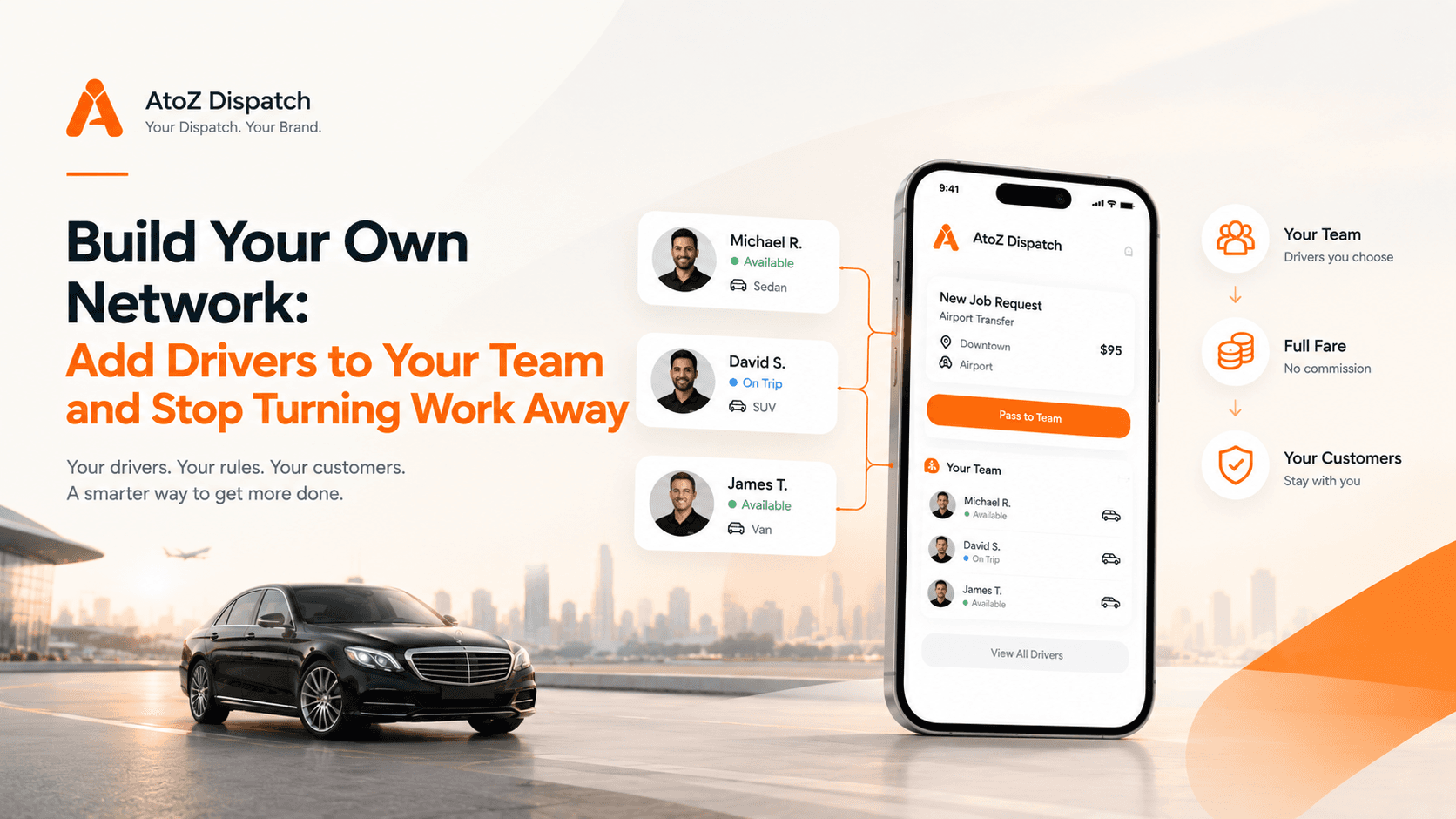
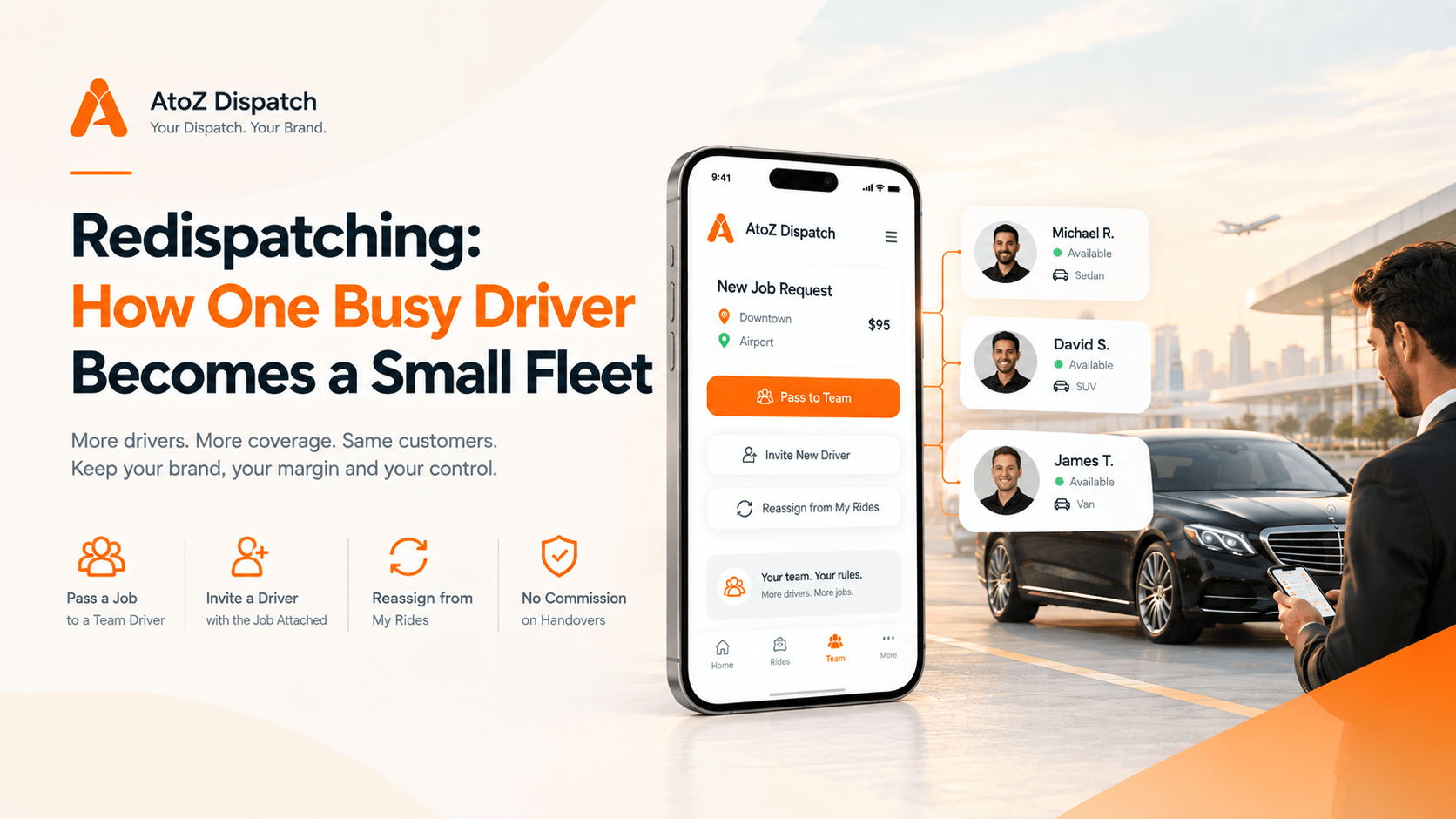
Redispatching means work arrives at you and you decide who runs it. A lead driver can pass a received job to a team driver, invite a new driver with the job attached, or reassign a job they had already accepted from My Rides. The customer, the brand and the margin stay with the operator, and no commission is taken on any handover.
Key points
- One driver can be in one place. A team of five can be in five. That is the whole economic argument.
- You remain the front door — the customer rang you — but you stop being the bottleneck.
- Three routes: pass a received job, invite a driver with the job attached, or reassign from My Rides.
- Quality protection is not software. It is that you chose these drivers.
- Grow the team when jobs start coming back unaccepted, not when you feel like growing.
- Redispatching does not create demand. A quiet phone is a marketing problem, not a capacity one.
One driver can be in one place. A team of five can be in five.
That sentence is the entire economic argument for redispatching, and everything below is about how to do it without losing the thing that made your business worth recommending.
What redispatching actually means
Work arrives at you. You decide who runs it.
That is the whole concept. You remain the front door — the customer rang you, the booking is yours, the relationship is yours — but you are no longer the bottleneck, because the driving can be done by any of several people.
The distinction that matters: you are not becoming a marketplace. A marketplace stands between a customer and whoever is nearest. You are standing in front of your own customers with more capacity behind you.
Three ways work reaches a team driver
Pass a job you have just received. It came in, you cannot run it, you send it to a team driver. They accept and it is theirs.
Invite a driver with the job attached. The driver is not on the platform yet. Send the invitation with the work inside it — email and SMS, app download, vehicle, licence and photo, then accept.
Reassign a job you had already accepted. From My Rides. Your morning changed, the airport run did not. Hand it over rather than ringing round.
Between them these cover almost every real situation, including the awkward one where you said yes and then something happened.
Keeping quality when you are not the one driving
This is the genuine risk and it deserves a straight answer.
The protection is not software. It is that you chose these drivers. A marketplace matches your customer to whoever is closest and available. You matched your customer to somebody whose car you have seen.
Beyond that, three habits do most of the work:
Agree standards once, in writing, in plain language. Vehicle presentation, dress, arrival time, what to do if the passenger is late.
Start people on the jobs you can afford to get wrong. Not the wedding. Not the account client's chairman. The Tuesday afternoon station run.
Watch the console rather than the driver. The My Team view shows who you have passed jobs to and how many. A driver who takes work is a driver who is available. A driver who never appears is a name on a list, not capacity.
When to add the next driver
The signal is not ambition. It is jobs coming back unaccepted.
When a job returns because nobody on your team could take it, that is the moment your capacity is genuinely short. Before that, adding drivers just dilutes the work each one gets, and drivers who never get work stop answering.
Grow when the returns start, not when you feel like growing.
What you keep
Worth being explicit, because this is what separates it from farming work to a platform.
The customer. They booked you. Their details are in your system.
The margin. AtoZ takes no commission on any booking. Not on the ones you drive and not on the ones you hand over. The money between you and your driver is your arrangement.
The brand. Everything the customer sees carries your name. So does the app your driver uses.
The record. Every trip, every driver, every fare, in one dispatch board you own.
The honest limits
Redispatching does not create demand. If the phone is not ringing, a team of five will not fix it — you have a marketing problem, not a capacity problem.
It does not remove the management. You are now responsible for other people's work in front of your customers, and that is a real job even when it is only two drivers.
And it does not settle your legal position. How a team driver is classified where you operate is a question for your accountant and your insurer, and the answer differs by state and country.
How to start with us
If you are on AtoZ already, all three routes are in your app now.
If you are looking from outside: Team 5 is $149 a month with a $499 one-time setup, Team 25 is $299 with $699 setup, Team 50 is $399 with $799. Team 25 is where most growing operators land.
Setup, onboarding, migration, unlimited vehicles and unlimited reservations are included, and there is no commission on anything.
Match the plan to the number of chauffeurs you expect to have, not the number you have today, and we will tell you honestly if a smaller plan is the right one.
The platform is white-label throughout — your logo, your domain, your app-store accounts — and Team plans go fully live in 21 working days.
The fastest way to judge it is a demo, where you can watch a job move from one phone to another and ask what you actually want to know. Book at atozdispatch.com/book-demo, or call, text or WhatsApp 302 499 1612.
Working with operators since 2006. Your brand, your rules, your revenue.
Frequently asked questions
Q: How does a lead driver distribute jobs across a team?
A: Three ways: pass on a job you have just received, invite a driver who is not yet on the platform with the job attached, or reassign a job you had already accepted from My Rides.
Q: Is redispatching the same as running a marketplace?
A: No. A marketplace stands between a customer and whoever is nearest. Redispatching puts more capacity behind your own front door — the customer booked you and stays yours.
Q: How do I keep quality when I am not driving the job?
A: By choosing the drivers yourself, agreeing standards once in plain language, and starting new drivers on jobs you could afford to get wrong.
Q: When should I add another driver to the team?
A: When jobs start returning unaccepted. That is real capacity shortage. Before that, more drivers just means less work each.
Q: Does AtoZ take a cut of a redispatched job?
A: No. AtoZ takes no commission on any booking, including work you hand to your own team.
Q: Will redispatching fix a quiet month?
A: No. It adds capacity, not demand. If the phone is not ringing you have a marketing problem, not a capacity problem.